
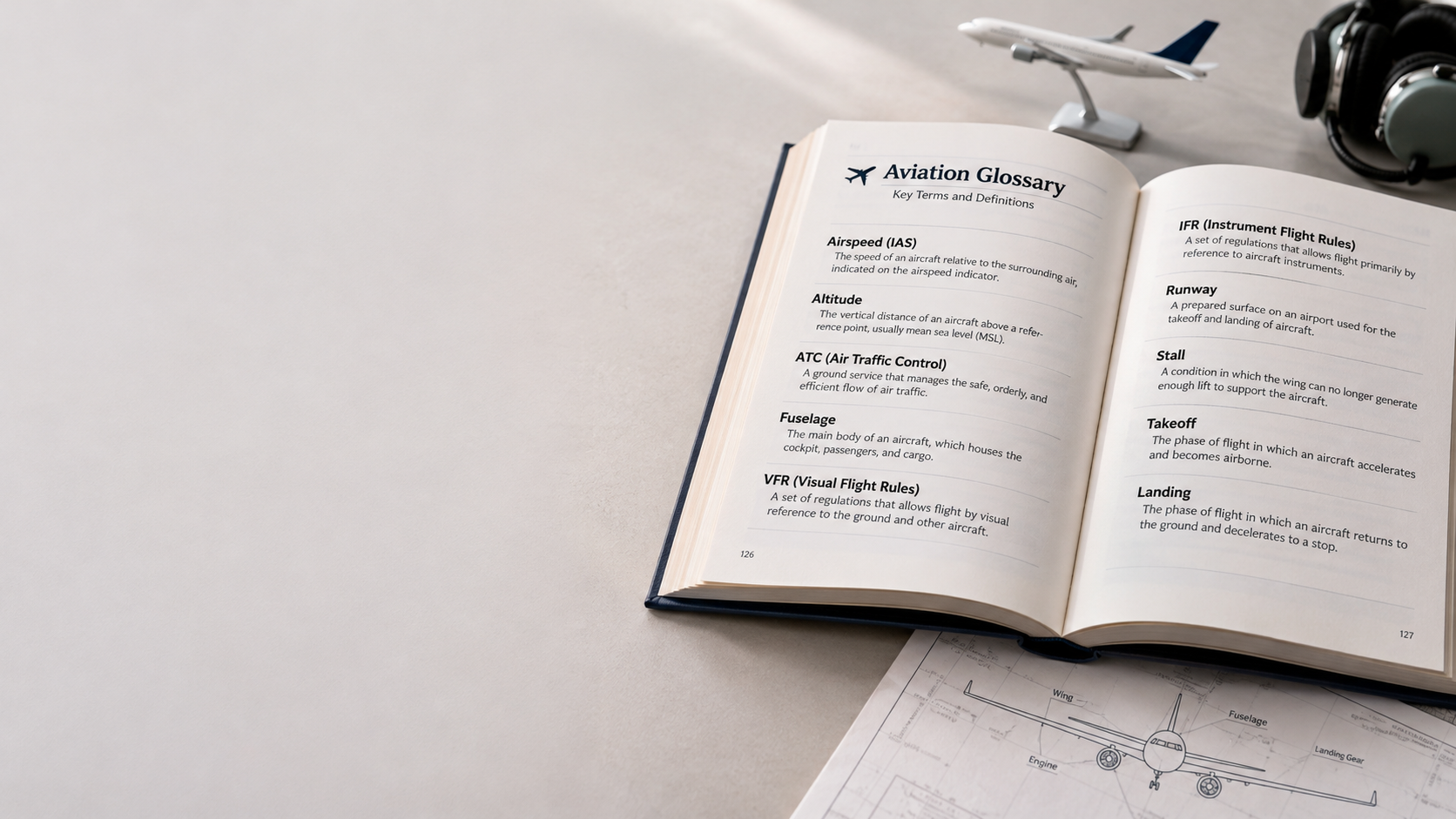
Aviation Glossary
Aviation comes with its own language. If you're thinking about becoming a pilot, you'll quickly encounter new acronyms, certificates, ratings, procedures, and technical terms. This glossary explains some of the most common terms you'll hear during flight training in plain English. Whether you're researching your first flight lesson or working toward a professional flying career, use this page as a quick reference along the way.
Want a more comprehensive resource? Download the FAA Pilot's Handbook of Aeronautical Knowledge.
ACS — Airman Certification Standards
The FAA standards used to evaluate applicants for many pilot certificates and ratings. The ACS outlines the knowledge, skills, and risk-management abilities you're expected to demonstrate during your practical test, commonly called a checkride.
ADM — Aeronautical Decision-Making
The process pilots use to identify hazards, evaluate risks, and make safe decisions before and during a flight. Good decision-making is a major part of becoming a safe, capable pilot.
AGL — Above Ground Level
Altitude measured from the surface of the ground directly below the aircraft. For example, an airplane flying 1,000 feet above the terrain is 1,000 feet AGL.
ASEL — Airplane Single-Engine Land
An FAA aircraft class rating for single-engine airplanes designed to operate from land. Most students earning a Private Pilot Certificate begin in an ASEL aircraft such as a Cessna 172.
AMEL — Airplane Multi-Engine Land
An FAA aircraft class rating allowing a properly certificated pilot to operate airplanes with more than one engine that are designed to operate from land.
Airspace
Areas of the sky categorized by the FAA based on factors such as traffic, location, and the type of air traffic control services provided. Different classes of airspace have different operating and communication requirements.
Airspeed
The speed of an aircraft relative to the surrounding air. Pilots use several types of airspeed measurements when operating an aircraft.
Altimeter
An aircraft instrument that indicates altitude based on atmospheric pressure.
ATC — Air Traffic Control
The system of controllers and facilities that helps organize aircraft traffic and provides services such as clearances, traffic separation, and flight information.
ATIS — Automatic Terminal Information Service
A continuously broadcast recording at many airports that provides pilots with current airport information such as weather, active runways, and relevant notices.
ATP — Airline Transport Pilot
The highest level of FAA pilot certificate. ATP certification is required for certain airline flight operations and represents an advanced level of aeronautical experience and training.
BasicMed
An alternative way for some eligible pilots to meet FAA medical requirements without holding a traditional FAA medical certificate. Eligibility and operating limitations apply.
BFR — Biennial Flight Review
A common older term for what the FAA now simply calls a Flight Review. Pilots still frequently use "BFR" in everyday conversation.
Ceiling
The height above the ground of the lowest cloud layer reported as broken or overcast, or the vertical visibility into an obscuration. Ceiling is an important consideration when evaluating flying conditions.
CFI — Certified Flight Instructor
Common shorthand for a flight instructor who holds the appropriate FAA flight instructor certificate and rating. CFIs provide flight instruction and help students develop the knowledge and skills required to become pilots.
CFII — Certified Flight Instructor – Instrument
Common shorthand for a flight instructor who is qualified to provide instrument flight instruction.
Checkride
The common aviation term for an FAA practical test. A checkride typically includes an oral portion followed by a flight portion with an authorized examiner.
Commercial Pilot Certificate
An FAA pilot certificate that allows a pilot to exercise commercial pilot privileges, including certain operations involving compensation or hire. Additional regulations govern which commercial operations a pilot may perform.
Complex Airplane
An airplane equipped with certain advanced systems, typically including retractable landing gear, flaps, and a controllable-pitch propeller or qualifying equivalent system.
Cross-Country Flight
A flight involving travel between locations rather than remaining in the immediate airport area. The FAA has specific definitions of cross-country time depending on which certificate, rating, or aeronautical experience requirement is involved.
Currency
Meeting the FAA's recent-experience requirements for a particular type of flying. Being legally current does not necessarily mean a pilot is proficient.
DPE — Designated Pilot Examiner
An individual authorized by the FAA to conduct practical tests for pilot certificates and ratings.
Discovery Flight
An introductory flight designed for someone interested in learning to fly. You'll typically fly with a flight instructor, learn about the aircraft and flight training process, and may have the opportunity to operate the controls during the flight.
Dual Received
Flight time during which you are receiving instruction from an authorized flight instructor. This training is recorded in your pilot logbook.
Endorsement
A written authorization from a flight instructor verifying that a pilot has received specific training or is prepared to exercise certain privileges. Students receive endorsements for milestones such as solo flight and practical tests.
FAA — Federal Aviation Administration
The U.S. government agency responsible for regulating civil aviation, including pilot certification, aircraft operations, airspace, and aviation safety.
FAR/AIM
A commonly used publication combining Federal Aviation Regulations relevant to pilots with the FAA's Aeronautical Information Manual. It is a standard reference for pilots and student pilots.
Flight Review
Periodic training required for most pilots to continue acting as pilot in command. A standard flight review includes ground and flight instruction and generally must be completed every 24 calendar months unless another qualifying activity satisfies the requirement.
Flight Time
Time that qualifies as aeronautical experience under FAA regulations. Different types of flight time—including dual instruction, solo, pilot-in-command, instrument, and cross-country time—may be logged separately.
Full-Stop Landing
A landing in which the aircraft comes to a complete stop rather than immediately taking off again.
Glass Cockpit
An aircraft cockpit that uses electronic flight displays instead of primarily traditional mechanical instruments. Modern training aircraft may use systems such as Garmin integrated avionics.
Go-Around
A procedure in which a pilot discontinues a landing attempt and climbs away from the runway to make another approach. Going around is a normal aviation procedure when conditions aren't right for a safe landing.
Ground School
The academic portion of pilot training. Ground instruction covers subjects such as weather, regulations, navigation, aerodynamics, aircraft systems, and flight planning.
Ground Reference Maneuvers
Training maneuvers performed while using visual references on the ground. They help student pilots understand aircraft control, wind correction, and the relationship between the airplane's flight path and the surface below.
High-Performance Airplane
Under FAA regulations, an airplane with an engine of more than 200 horsepower. Pilots generally need specific training and an instructor endorsement before acting as pilot in command of a high-performance airplane.
Hobbs Meter
A meter commonly used to measure the amount of time an aircraft is operating. Flight schools often use Hobbs time when recording aircraft rental or instructional time.
IFR — Instrument Flight Rules
Rules governing flight when pilots navigate primarily by aircraft instruments and operate within the air traffic control system under an IFR clearance. Pilots must have appropriate training and qualifications to act as pilot in command under IFR.
IMC — Instrument Meteorological Conditions
Weather conditions that do not meet the requirements for visual flight. Pilots operating in IMC generally rely on aircraft instruments rather than outside visual references.
Instrument Approach
A published procedure that allows an appropriately qualified pilot to navigate toward and approach an airport primarily using aircraft instruments and navigation systems.
Instrument Rating
An additional rating that allows a pilot to operate under Instrument Flight Rules when appropriately equipped, current, and qualified. Instrument training develops skills for flying primarily by reference to the aircraft's instruments.
Knowledge Test
An FAA written examination required for many pilot certificates and ratings. You'll often hear pilots casually call it the "written test," even though it is normally completed electronically at an authorized testing center.
Knot
A unit of speed equal to one nautical mile per hour. Aircraft speeds and winds are commonly reported in knots.
Logbook
The record a pilot uses to document flight experience, training, endorsements, and other required aeronautical experience. Logbooks may be paper or electronic.
Medical Certificate
An FAA-issued certificate showing that a pilot meets the applicable medical requirements for certain flight privileges. Different classes of medical certificates apply to different types of flying.
MEI — Multi-Engine Instructor
Common shorthand for a flight instructor who holds the appropriate qualifications to provide instruction in multi-engine airplanes.
METAR
A standardized aviation weather report describing current conditions at an airport or weather-reporting station. METARs typically include information such as wind, visibility, clouds, temperature, and atmospheric pressure.
MSL — Mean Sea Level
Altitude measured relative to average sea level. Aircraft altitudes, airport elevations, and many aviation charts use MSL.
Multi-Engine Rating
A class rating that allows a pilot to operate airplanes with more than one engine when combined with the appropriate pilot certificate and category rating.
Nautical Mile
A unit of distance used in aviation and marine navigation. One nautical mile equals approximately 1.15 statute miles.
Night Flight
Flight conducted during nighttime conditions. FAA regulations use specific definitions of night for different purposes, including logging flight time and carrying passengers.
NOTAM — Notice to Air Missions
Time-sensitive information provided to pilots about conditions that may affect a flight, such as runway closures, navigation equipment outages, temporary restrictions, or other operational changes.
Part 61
The section of FAA regulations containing many of the rules governing pilot certification and flight training. Training conducted under Part 61 can offer significant flexibility in scheduling and training progression.
Part 141
FAA regulations governing certificated pilot schools that operate using an FAA-approved training curriculum. Part 141 programs follow a structured syllabus and specific training requirements.
PIC — Pilot in Command
The pilot who has final authority and responsibility for the operation and safety of a flight. FAA rules also determine when flight time may be logged as PIC time.
Pilot Certificate
The FAA credential authorizing an individual to exercise specific pilot privileges. Although people often say "pilot license," the FAA formally issues pilot certificates.
Pilot License
A common informal term for a pilot certificate. In the United States, the FAA officially uses the term pilot certificate rather than pilot license.
PPL — Private Pilot License
A widely used informal abbreviation for the Private Pilot Certificate. "PPL" is commonly used by students and pilots even though Private Pilot Certificate is the FAA terminology.
Practical Test
The FAA evaluation used to earn many pilot certificates and ratings. Pilots commonly refer to the practical test as a checkride.
Preflight Inspection
A systematic inspection of an aircraft performed before flight to determine whether the aircraft appears safe and suitable for operation.
Private Pilot Certificate
For many pilots, the first major FAA pilot certificate they earn. It allows qualified pilots to act as pilot in command and carry passengers, subject to applicable FAA rules and limitations.
Proficiency
A pilot's actual ability to perform flying tasks safely and competently. A pilot may meet the legal requirements for currency while still choosing to receive additional training to maintain or improve proficiency.
Rating
An authorization added to a pilot certificate that expands the aircraft or operations the pilot is qualified to perform. Examples include an Instrument Rating or an Airplane Multi-Engine Land rating.
R-ATP — Restricted Airline Transport Pilot
A Restricted ATP allows qualifying pilots who meet specific FAA requirements to exercise certain ATP privileges with less than the flight experience normally required for an unrestricted ATP certificate.
Runway
A defined area at an airport prepared for aircraft takeoffs and landings. Runways are numbered based approximately on their magnetic direction.
Safety Pilot
A qualified pilot who helps maintain visual observation while another pilot practices instrument flying using a view-limiting device. Specific FAA requirements determine who may serve as a safety pilot.
Simulator
A general term often used for devices that recreate aspects of flying an aircraft. FAA-approved flight simulation training devices and aviation training devices may allow certain training or experience to receive regulatory credit when used in accordance with applicable rules.
Solo Flight
A flight in which a student pilot operates the aircraft without an instructor or another person aboard. A student's first solo is one of the biggest milestones in flight training.
Spin
An aggravated stall in which an aircraft follows a descending, rotating flight path. Spin awareness and recovery training help pilots understand how spins develop and how they can be prevented or recovered from when appropriate.
Stage Check
A progress evaluation commonly used within structured flight-training programs. Stage checks help determine whether a student has mastered the material required before advancing to the next portion of training.
Stall
An aerodynamic condition that occurs when an aircraft wing exceeds its critical angle of attack, disrupting normal airflow and reducing lift. Stall recognition, prevention, and recovery are fundamental parts of pilot training.
Student Pilot Certificate
An FAA certificate that allows a student pilot to exercise student pilot privileges when the appropriate requirements and instructor endorsements have been met.
Tach Time
Aircraft operating time measured using the engine's tachometer. Tach time accumulates based partly on engine speed and may differ from Hobbs time.
TAF — Terminal Aerodrome Forecast
An aviation weather forecast for conditions expected near certain airports during a specified period.
Technically Advanced Airplane — TAA
An airplane equipped with a defined combination of advanced electronic flight displays and an integrated autopilot system. TAAs are commonly used in modern flight training.
Touch-and-Go
A landing in which the aircraft touches down and then takes off again without coming to a full stop. Touch-and-goes allow pilots to efficiently practice multiple takeoffs and landings.
Traffic Pattern
A standardized path aircraft fly around an airport when arriving, departing, or practicing takeoffs and landings. The pattern helps pilots organize traffic and anticipate the movements of other aircraft.
Type Rating
A specific qualification required to operate certain aircraft, generally including large or turbojet-powered airplanes and other aircraft for which the FAA requires a type rating.
VFR — Visual Flight Rules
Rules governing flight when weather conditions allow pilots to operate primarily using outside visual references. Much of a student's initial flight training takes place under VFR.
VMC — Visual Meteorological Conditions
Weather conditions that meet the applicable requirements for flight under Visual Flight Rules.
V-speeds
Published airspeeds associated with specific aircraft operations or limitations. Examples include rotation speed, best-angle climb speed, best-rate climb speed, and never-exceed speed.
Weight and Balance
The process of determining whether an aircraft's total weight and center of gravity are within approved limits. Proper weight and balance calculations are essential for safe aircraft performance.
Written Test
The common informal name for the FAA Knowledge Test. Although pilots still frequently call it the written, FAA knowledge exams are generally computer-based.