
Career Pilot Pathway: How to Become a Professional Pilot
Have you ever looked up at an airplane flying overhead and wondered what it would take to be the person at the controls?
Whether your dream is to fly for a major airline, operate corporate jets, or pursue another career in aviation, becoming a professional pilot starts with the same thing: learning to fly.
But how do you turn that first flight lesson into a career?
The path involves earning pilot certificates and ratings, developing your flying skills, and building experience along the way. While the journey takes dedication, understanding the steps can help you make informed decisions about your training.
Here's what you need to know.
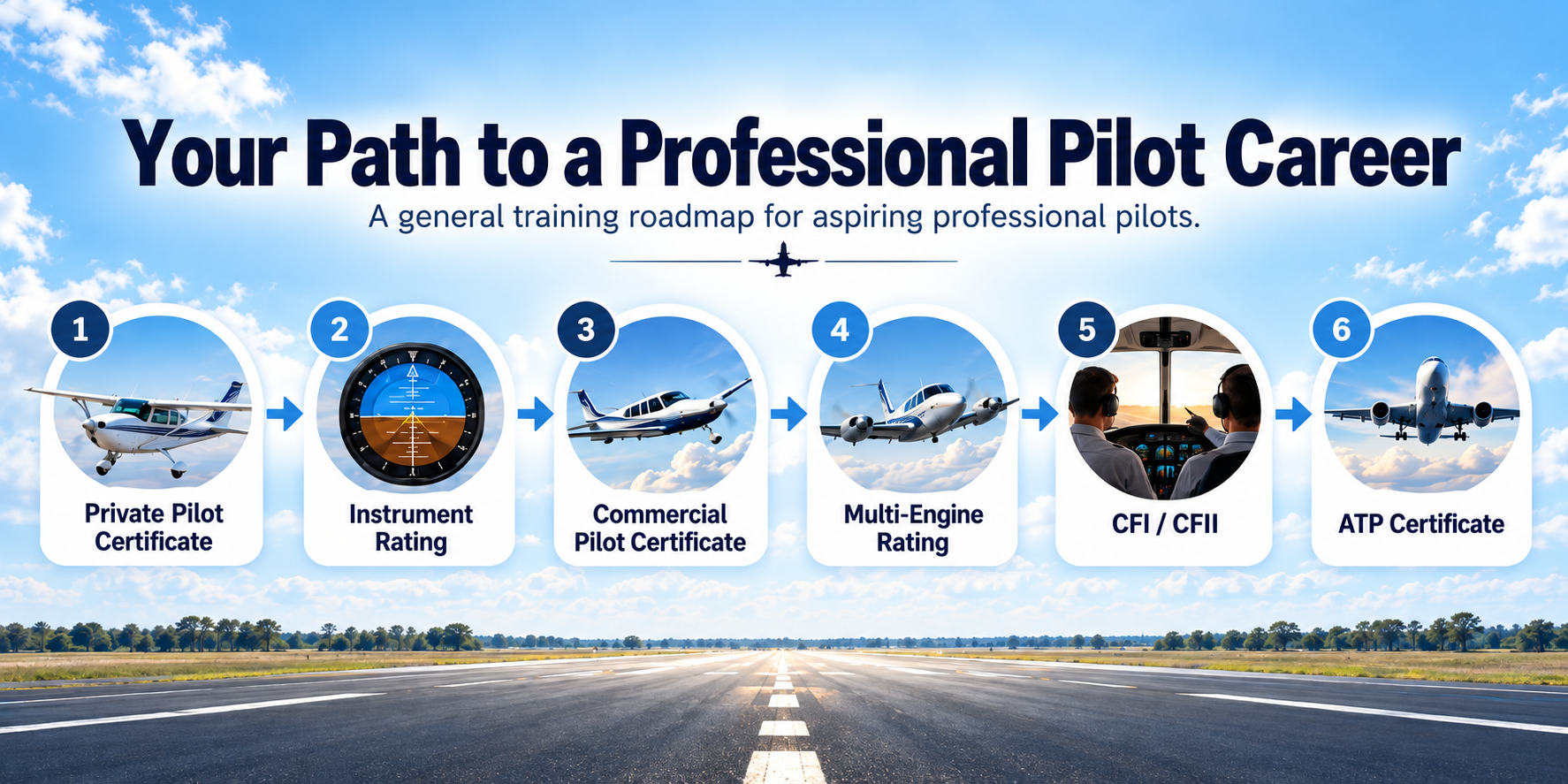
Step 1: Earn Your Private Pilot Certificate
Your journey begins with earning your Private Pilot Certificate (PPL).
This is where you'll learn the fundamentals of flying, including aircraft operations, navigation, weather, communication, and flight safety.
You'll work with a certified flight instructor, practice essential maneuvers, complete your first solo flight, and eventually demonstrate your knowledge and flying skills during a practical test, commonly called a checkride.
The FAA requires a minimum of 40 flight hours for a Private Pilot Certificate under Part 61, although many students need additional training before they're ready.
A Private Pilot Certificate allows you to fly for personal purposes, but it generally doesn't allow you to be paid for flying.
Think of it as the foundation for everything that comes next.
Step 2: Earn Your Instrument Rating
Once you've earned your Private Pilot Certificate, the next major milestone is typically an Instrument Rating.
As a private pilot, you'll initially train to fly primarily using visual references outside the aircraft. An Instrument Rating teaches you to operate under Instrument Flight Rules (IFR), using aircraft instruments and established procedures to navigate and fly safely when outside visual references are limited.
During instrument training, you'll develop skills in:
- Flying and navigating by reference to instruments
- Understanding instrument approach procedures
- Communicating with air traffic control
- Planning and conducting flights under IFR
- Making sound decisions in challenging weather conditions
Instrument training is an important step toward becoming a professional pilot because it develops the precision, situational awareness, and decision-making skills needed for more advanced flying.
Step 3: Earn Your Commercial Pilot Certificate
This is where your training begins transitioning from recreational flying toward a professional career.
A Commercial Pilot Certificate allows you to be compensated for certain types of flying, subject to applicable FAA regulations and operating requirements.
Commercial pilot training focuses on developing greater precision, advanced aircraft handling, aeronautical knowledge, and professional-level decision-making.
Under the traditional Part 61 training pathway, applicants generally need at least 250 hours of flight time to qualify for a Commercial Pilot Certificate, along with meeting other aeronautical experience requirements.
Earning your commercial certificate is a major accomplishment, but it doesn't automatically qualify you to fly for an airline. Most professional flying positions require additional experience, qualifications, or both.
That's where the next stages come in.
Step 4: Add a Multi-Engine Rating
Many professional aircraft, including airliners and numerous corporate aircraft, have more than one engine.
A Multi-Engine Rating allows you to operate aircraft equipped with multiple engines within the privileges of your pilot certificate.
During multi-engine training, you'll learn about aircraft performance, systems, handling characteristics, and procedures for operating safely when an engine fails.
At Tradewind Flight Training Center, students can pursue multi-engine training in our Piper Seminole, gaining experience with the additional complexity of operating a twin-engine aircraft.
A Multi-Engine Rating is an important qualification for pilots pursuing many airline, corporate, and other professional aviation opportunities.
Step 5: Build Flight Experience
One of the biggest differences between earning a Commercial Pilot Certificate and qualifying for many professional flying jobs is experience.
Professional pilots need more than certificates. They need the judgment, confidence, and practical skills that come from spending time in the cockpit.
One common way to build that experience is by becoming a Certified Flight Instructor (CFI).
As a flight instructor, you can help new students learn to fly while continuing to develop your own skills and accumulate flight time.
Some pilots also earn their Certified Flight Instructor-Instrument (CFII) qualification, allowing them to provide additional types of instrument instruction.
Flight instruction isn't the only way to build experience. Depending on qualifications and available opportunities, commercial pilots may also pursue other types of flying jobs.
The right approach depends on your long-term career goals.
Step 6: Work Toward Your Airline Transport Pilot Certificate
For pilots pursuing an airline career, the Airline Transport Pilot (ATP) Certificate is a major milestone.
The ATP Certificate represents the highest level of pilot certification issued by the FAA and is required for most airline pilot positions.
A standard unrestricted airplane ATP Certificate generally requires at least 1,500 hours of total flight time, along with other specific experience, knowledge, and eligibility requirements.
Some pilots qualify for a Restricted ATP Certificate with fewer hours through approved pathways, including certain military and collegiate aviation programs.
Not every professional pilot needs an ATP Certificate. Requirements depend on the aircraft, type of operation, and career you're pursuing.
For aspiring airline pilots, however, earning the necessary experience and qualifications to pursue an ATP Certificate is an important part of the journey.
How Long Does It Take to Become a Professional Pilot?
There's no single timeline that works for everyone.
Your training schedule, financial resources, previous flight experience, and career goals all influence how long the process takes.
Someone training several days per week may progress differently from someone balancing flight lessons with a full-time job.
It's also important to distinguish between earning your Commercial Pilot Certificate and accumulating the additional experience needed for an airline or other professional flying position.
Becoming a professional pilot is a series of milestones, not one final test.
The key is developing a realistic training plan that keeps you moving toward your goals.